Supply-chain security Making it possible to check that a download is exactly what the source code says: signed provenance, SBOMs, reproducible packages and the OpenSSF Best Practices gold badge for bitg.
From zero to OpenSSF gold in under two days
bitg's repository was created on 11 November 2026 at 17:08 UTC. The project reached the OpenSSF Best Practices gold level 36 hours later. Most of the code-side criteria took hours; the hardest ones were about people, and one we marked wrongly before correcting it.
Reproducible MSI and .pkg builds, and the timestamp traps inside
Building the bitg installers twice from one commit used to give two different files. We removed the differences layer by layer: compiler, linker, WiX, the OLE container, and the xar archive behind every macOS package. The last four bytes were written by the very call that saved our fix.
01 / 02
- From zero to OpenSSF gold in under two days bitg's repository was created on 11 November 2026 at 17:08 UTC. The project reached the OpenSSF Best Practices gold level 36 hours later. Most of the code-side criteria took hours; the hardest ones were about people, and one we marked wrongly before correcting it.
- Reproducible MSI and .pkg builds, and the timestamp traps inside Building the bitg installers twice from one commit used to give two different files. We removed the differences layer by layer: compiler, linker, WiX, the OLE container, and the xar archive behind every macOS package. The last four bytes were written by the very call that saved our fix.
- From zero to OpenSSF gold in under two days bitg's repository was created on 11 November 2026 at 17:08 UTC. The project reached the OpenSSF Best Practices gold level 36 hours later. Most of the code-side criteria took hours; the hardest ones were about people, and one we marked wrongly before correcting it.
- Reproducible MSI and .pkg builds, and the timestamp traps inside Building the bitg installers twice from one commit used to give two different files. We removed the differences layer by layer: compiler, linker, WiX, the OLE container, and the xar archive behind every macOS package. The last four bytes were written by the very call that saved our fix.
Nothing matches your search
Try a shorter word, or clear the search to see every post.
Related products
Explore work from other areas
- Agents and MCP 3 posts How AI agents should reach real systems: one gateway with scoped tokens, masking, audit and a kill switch, and products that expose their own tools — 96 of them in dtwin alone.
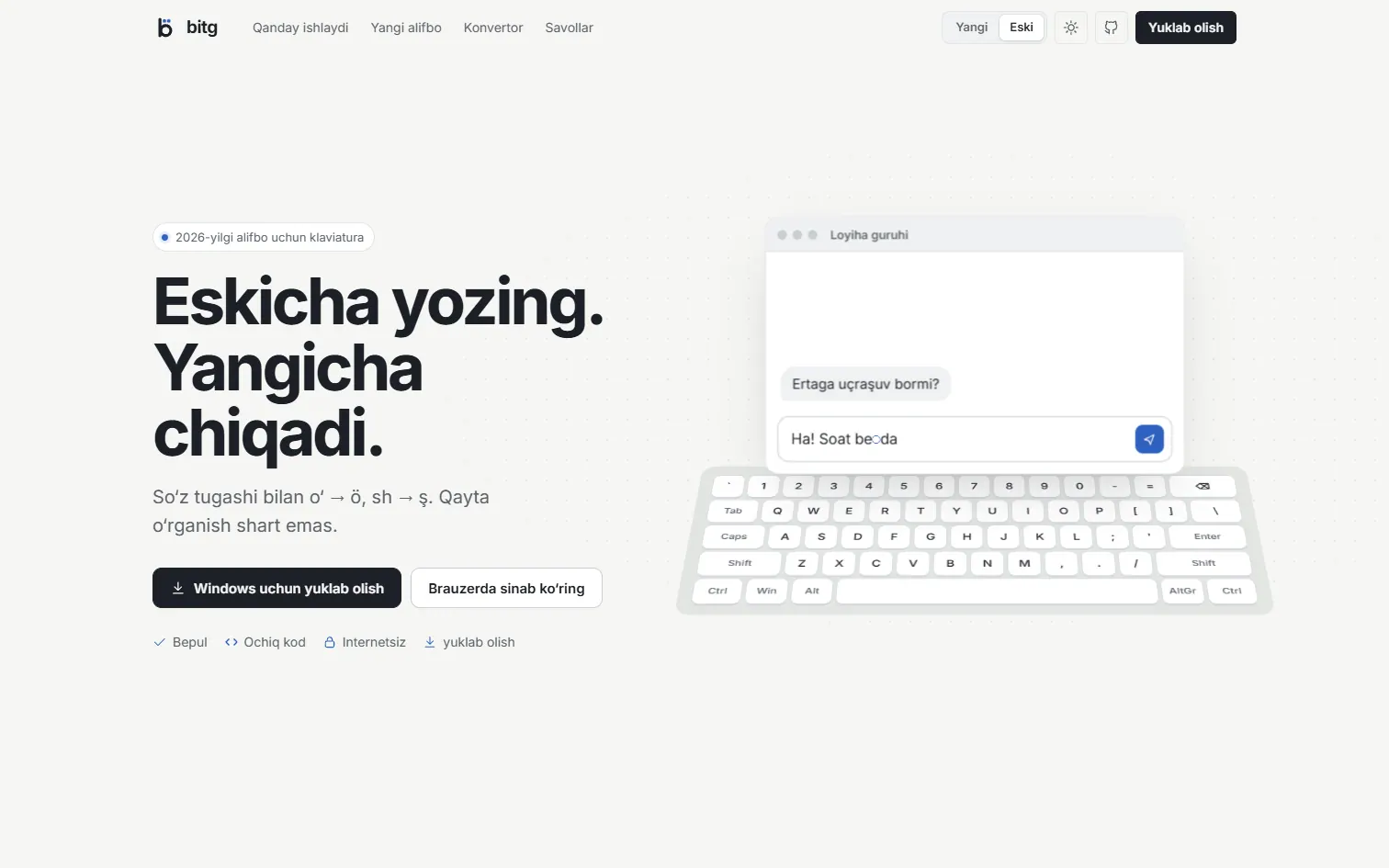
- Language technology 2 posts Tools for writing Uzbek well on every device — starting with bitg, a keyboard that converts text to the 2026 Latin alphabet as you type, measured at 98.87% on a public evaluation set.
- Infrastructure and reliability 2 posts Running many small products on modest hardware without dropping requests: zero-downtime releases, self-hosted tunnels, status checks and restores that are actually tested.
- Interfaces and 3D 3 posts Interfaces people remember: 3D scenes that stay fast, a brand film rendered from code, and pages that score 100 on Lighthouse without losing their motion.
- Faith and society 2 posts Software that respects how people actually organise their day: a planner anchored to the five daily prayers, 2,285 congregations mapped from OpenStreetMap, and missed-prayer planning.
- Digital assets 1 post Should a community app have a token at all? Our answer is still no, for reasons of Uzbek law, platform rules and Islamic finance. What we kept from the technology instead are three planned open tools without tokens, each with a working in-browser demo today: Muhr for timestamp proofs, Sanad for verifiable certificates and Shaffof for verifiable charity reports.
- Engineering 9 posts Notes from building and running the dtwin ecosystem: deploys, builds, incidents and the fixes behind them, with the commands to reproduce each one.
01 / 07